Blog Archives
In Seeing Yet not Of Sight
One of those phrases which are said far too often and almost flippantly, are believers, Christians, are “to be in the world but not of the world.” Usually it is a teacher or someone who is attempting to make a point through the use of this phrase, but no real, concrete explanation is ever given which would give meaning to the aphorism.
The listener is somewhat perplexed and unsure how to alter their behavior, so they can then avoid being “of the world.” I’m sure, in many instances, the frustration builds, and no attempt is made to alter their life. Thoughts of finding some kind of camouflage may even immediately be considered to avoid being detected . . . .by anyone!

While this saying usually sounds so much wiser than the wisdom actually imparted, the Apostle Paul, in the letter to the Romans, wrote to them saying, “Do not be conformed to this world, but be transformed by the renewal of your mind, that by testing you may discern what is the will of God, what is good and acceptable and perfect”(Romans 12:2 ESV).
The saying, “being in but not of the world,” is not in the Bible, but the principle is. The Apostle Paul, after spending eleven chapters informing the church in Rome of God’s plan, of how God chose people to be His in spite of the fact every single person had rejected Him and had chosen to worship the inferiority of creation rather than Him; He made a decision to choose some of us anyway.
Paul then demonstrated how on our own, no one would be able to come to Him through His Son. He then gave the example of Israel’s rejection of the Messiah—and how God will stillsave a remnant who will accept His Messiah Jesus. Then Paul concludes by telling the Roman Christians they should, as an act of worship, “present [their] bodies as a living sacrifice” which is their natural, spiritual worship response as a saved, redeemed people.
Okay, so far so good. Yet just as the saying of “we’re in the world but not of the world” sounds really cool in concept, how exactly does this occur? Paul doesn’t hesitate, but quickly adds the way, the mechanics which will allow this to occur: through “the renewal of our minds.”
When computers first started to become the ubiquitous necessity they are now, there 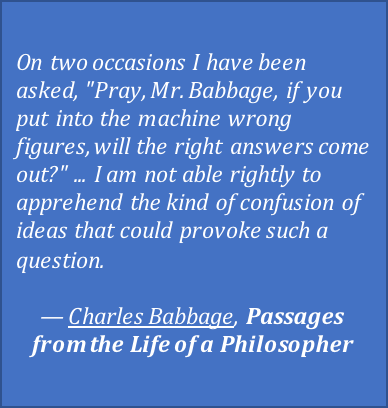 was an aphorism that was immediately recognizable and understood: “Garbage in, garbage out!” If you enter bad data, you will never—and have no hope of ever—get good data from the computer.
Paul understood this was true of people as well. We are created beings and the One who created us knows how we are made and what is needed for us to function well. While Paul is writing to Christians, this principle is true of all of humanity. If you eat junk food, if you consume violent or risqué media, do not be shocked when the cigarettes you smoke make you wheeze, the donuts keep you from seeing your toes and the media you allow in your mind affects your ability to think clearly and function normally.
One other note: the Greek word translated as conformed gives us the ability to understand this conformity with the world that literally “fashions us together with” the world so we cannot be separated from it. This is the same idea in camouflage. Regardless of who you are, you have made the choice to “blend in” so well, you cannot and will not be distinguishable from your surroundings.
So, let’s return to our confusing little homily: “in the world yet not of the world.” As believers in Jesus Christ, as those who Paul says have been “recreated” by the Spirit, we are literally “no longer of this world.” Just as a diver must wear an air tank, a mask and flippers to propel him through the water and to keep him alive, believers must breath faith, consume God’s Word, and we must depend on the power of the Holy Spirit.
Christians are to be different. “Different” does not mean weird! Different means we exist through our faith, we are sustained by God’s Word and we find our energy, our power through the Holy Spirit. As we use our faith, consume God’s Word and live by the Spirit’s power, we will find our conformity will be to Jesus Christ. Paul even said this clearly that every believer is “to be conformed to the image of His Son.”
We are “in” not “of.” The only way we can exist “in” is for us to “look like” Jesus Christ—literally, for people to “see Jesus,” when they see us.
Now that’s some great camouflage!
In re de somnium (The dream of Reality)
We’ve all said something like this: “They are their own worst enemy.”
What motivates us to make this kind of observation? Usually it’s due to individuals who seem to be captive of their own weaknesses which they either cannot see or cannot overcome.
Yet even while we may shake our heads as we walk away from someone who should have known when to stop talking, we must always keep this in mind: we are no different than they are. There are times in everyone’s life when we are simply unable to determine where we are or what we’re doing.
No matter how aware we believe ourselves to be, no matter how we may even pride ourselves on our ability to understand the consequences of our actions, time and again we demonstrate our inability to often see what is proverbially directly in front of us. It is almost as if our brains seem to work against our efforts to interpret our circumstances.
There is an old Chinese proverb which says, “If you want to understand water, do not ask a fish.”
Here’s the scenario: your wife has sent you upstairs to get a particular cleaner out of the closet (usually due to the fact you had the audacity to appear to be “un-busy” while she is busily “doing something”). You are familiar with this cleaner; you know what colors the bottle has on it, you even are familiar with the size and shape of the bottle, so off you go to check another victory off your list!
Unfortunately, the cleaner isn’t in the closet. You looked. It wasn’t there. So, you inform your wife that it isn’t in the closet (usually by increasing the volume of your voice so it will reach your wife who is still downstairs). After mere moments have passed, your wife comes to you. Of course, you are prepared for your vindication. You are confident of your situational assessment. You are prepared to receive your prize (trust me, this is a guy thing).
Reality, in these moments, becomes simultaneously displeasing and disappointing. Your wife reaches into the closet and turns to you and places the cleaner into your disbelieving hands. She then goes back downstairs while muttering an esteem-destroying narrative which further weakens one’s grip on one’s man-card….
So, you are standing there with the bottle of cleaner, attempting to process the reality of your ignominy, and you cannot fathom how you could be so wrong! And judging by the continued muttering of your wife downstairs, neither can she.
If your inability to have seen the cleaning bottle was a physical issue, this would have been referred to as a scotoma, a physical blind spot in one’s vision which makes one unable to see anything in the center of one’s vision. Yet very few people have a true diagnosed scotoma; while everyone has a blind-spot in their field of vision, few have the debilitative sort.
The reason our “man” example could not see the cleaner was a kind of scotoma, a mental one. I’ve done this very thing. The reason we do not see the very object for which we are searching is our minds have given us an image for which we were looking! If what our “eyes” see does not match our mental image, our brain immediately dismisses what is before us.
We are seeking. We desire to find a particular object. Yet because of what we are thinking our brain says it isn’t there!
It happened. We’re in the water but we don’t know it.
We have become our own worst enemy.
For the believer in Jesus Christ, this should cause us great chagrin and even alarm. If our minds so readily dismiss the reality in which we live simply because we have the wrong image of reality, how can we know we know? How can we avoid being our own worst enemy?
In Romans 8:26, the Apostle Paul informs us through the inspiration of the Holy Spirit, “For we do not know what to pray for as we ought, but the Spirit Himself intercedes for us with groanings too deep for words” (ESV).
Because God created us and because He knows us completely, He has placed His Spirit within everyone who has a relationship with Him through the Son Christ. One of the most overlooked benefits of the presence of the Spirit in the life of a believer is the Spirit, who is God, knows what we need—and what we should know—better than we do.
Perhaps we should remember the words of Arnold Schwarzenegger’s character in the 1990 movie Total Recall: “How do we know this isn’t a dream?”
There is great power and strength in our relationship with Christ! No, this doesn’t mean we must all live in fear of spoiling our relationship with Him because of what we could do. A few verses after the above reference, Paul adds that nothing in the list he gives “will be able to separate us from the love of God in Christ Jesus our Lord” (Romans 8:39 ESV).
So the next time you are looking for something you know you should be able to find, remember the gift God has given us so we can always find Him, we can always know His will and we will never be able to make any decision which will separate us from the love He has given to us in Christ through His sacrifice.
We will have defeated the enemy within us: ourselves.
Getting to Give
A friend of mine who was an amateur astronomer used to mention something to which he referred to as “seasonal creep.” He told me that the local astronomy club had studied about a twenty-year cycle and found that the seasons were “shifting” to later and later in the calendar year.

Winter in Springfield, Illinois
Even I could remember that as a child we would often get snow before Halloween. As I grew older the snows often did not come until the middle of December, with the strongest storms in January; over the past five-to-ten years I have also noticed that cool weather would also continue until early June.
Of course, anyone who ever enters our malls and shopping centers can attest to this seasonal creep as well! Halloween decorations appear near the first of September. Christmas arrives (at least in the stores) even before the end of October. I believe the main reason for this is a hope by retailers that people will begin to “get into the holiday mood” when they see the seasonal decorations.
The amazing thing is the amount of stuff that can be gotten during this time of year! When I was a child, our family did not have much “disposable” income: we always had plenty of food, clothes and basic necessities, but the things that my brothers and sisters just “wanted” were reserved for Christmas—and even then, we did not get everything we wanted!
In Acts 20:35, the Apostle Paul in his farewell address to the Ephesians, reminded them of his desire to serve the Ephesian believers and demonstrate his obedience to the words of Christ: “It is more blessed to give than to receive.” While Paul desired to live out who Jesus was in his life, Paul never taught that getting was wrong or evil; yet Jesus merely pointed out to him that giving provided a greater blessing.
Thankfully, those of us who know Jesus Christ as their Lord and Savior, serve a God who freely gives us all the things of which we have need! From the beginning of the Bible in Genesis, we witness a God who created this world and then chose to give it to Adam and Eve to enjoy.
God later in Exodus gave his people the Ten Commandments so they would be able to have a relationship with a holy God. Later, God gave David’s son Solomon the intelligence and imagination to build the Temple—thus giving His people a most holy place to maintain their relationship with Him. More importantly, John records the words of Christ in John 3:16 where we read that God loved the people of this world so much He gave His Son to be our sacrifice—and He also gave us His Spirit to prove we belong to Him!
“So should we deprive ourselves of material goods to be ‘better’ people?” No, that thought misses the point. Yet during this holiday season allow me to propose this: Jesus in Matthew 5-7, which is the Sermon on the Mount, stated those who truly “are” His would be both salt and light to those in this dark world. Those who are truly changed by God’s Spirit will also in turn demonstrate that change to those in this world.
We should remember the mantra that says, “A difference that makes no difference is not then different.” If we have been changed by God, that change must be evident in our lives.
So, what about giving being better than receiving? We serve a God who gives! While God gives, not everyone receives; the gift is there, it is offered but few take it. Yet as God gives, and we in turn receive. Paul concludes in 2 Corinthians 5:17 that we are a new creation; our old lives, our old desires have been removed. True, we struggle with this, but we also must realize before accepting God’s gifts, we sinned because it was the natural thing to do. When we sin as a believer, it is an unnatural thing and we do it willfully and in rebellion to our Creator—unnaturally!
It all boils down to this: God gives, we get—but in this “getting” we in turn can give! This giving can be concrete (by imparting gifts to another), or it can be more abstract (by demonstrating how Christ has changed us through our actions). We are commanded to give through demonstrating our love for Christ through our obedience to Him and through our missional actions of going, doing and telling others about Jesus Christ.
If you think getting that hoped-for-gift would bring joy to your life, have you ever considered what it would feel like to give something of eternal value and everlasting consequences?
joyeux Noël!
Feliz Navidad!
Fröhliche Weihnachten!
счастливого Рождества
Wesołych Świąt
Merry Christmas!
 Life. Seriously? Funny!
Get This?
Jul 25
Posted by Jim Grieme
I get it.
There are many professing Christians—or even those who market themselves under the moniker of “faith”—who possess an innate ability to repulse people. While I have met (and even know) people with this particular trait, it is inconsistent with the teachings of the Bible. If you claim to know Jesus Christ and practice Christianity, God expects us to act like his Son.
From a practical and anecdotal standpoint, Buddhism, Hinduism, Mormonism, Judaism, and Atheism do not give Christianity a bad name; Christians do. Yet the spiritual element cannot be overlooked. While those who reject the idea or concept of an unseen world may find this statement self-serving, it nonetheless remains a fact.
What is done, the actions of people, do not occur in a vacuum. When there is a crime, investigators not only seek what was done but they look for why it was done—the motive. True, some may quibble over terminology and may reply the workings of the mind cause action, I aver while the mind may give reasons for the “why,” this explanation cannot answer from where the “why” originated.
The collective “a-ha” now builds, allowing for the “nature vs. nurture” argument to be applied. Yet this is unsatisfactory. Nature and nurture only allow for the responsibility of an action or actions to be placed elsewhere. This explanation seeks to indict those in the past, not making an argument for the action at hand nor providing a prima facie reason for an action to occur.
Do we ever ask, as a people, to seek the reason something occurs and desire to identify an individual or individuals who are responsible? To claim two brothers were raised in an abusive family environment still cannot assuage the curiosity of those seeking to find both a “why” and the place from “where” such an action originated as these two brothers killed their biological parents. Even in the Bryan Kohberger murder trial, his plea of guilt avoided the death penalty yet failed to provide answers for the families of those killed.
Again, I get it. From the Theo Bros on YouTube to people who assume if you don’t vote exactly like they do you ride the proverbial roller-skate through the gates of Hell, there are many annoyingly loud voices who claim Jesus Christ. Yet they do so as they manage to “annoy the Hell out of the people” they claim are going to Hell. Allow me to point out the Bible never resorts to such imbecilic methodology.
God’s Word (the Bible) is quite clear: every single person that has lived, does live, or will live is destined to spend their life apart from God from the moment they are conceived (Take a breath! Save it for another post). No one fitting the above-mentioned criteria knows for sure who belongs to God or who does not (beyond doubt). Those who belong to God, however, must live like they belong to him. Politics, group identification, personal preferences, clothing, housing, or geography must all take a back seat to what is most important: Jesus Christ.
The Apostle Paul, a man who endured incredible suffering through loss and pain for his Lord, wrote a small church in the city of Phillipi saying, “Indeed, I count everything as loss because of the surpassing worth of knowing Christ Jesus my Lord. For his sake I have suffered the loss of all things and count them as rubbish, in order that I may gain Christ.” Nothing political, economic, national, or personal is more important or worth more than knowing Jesus Christ as Lord.
That people are sinful, selfish, spiteful, and treat things not religious as their religion demonstrates imperfection firstly, not whether they are known by God as his. Yet those who claim Christ—true and genuinely so—should possess the humility to own up to their error and sin. What a Christian has in Christ is not because they are better but rather Jesus Christ is.
I get it.
In all the grace-laden humility I have received from Jesus Christ, I ask those of you festering something akin to hatred for Christianity to consider this: do not look for an accurate picture of Jesus Christ in your fellow humanity. I ask that you see people with something rarely experienced in our society and culture: recognize them as people like yourself. Weak, inconsistent, imperfect, and prone to being a royal pain in the hind parts of many.
Because you can only see God when you ask to see Jesus Christ. If you find yourself moved to think and act this way realize it’s not you on your own desiring this. It is the Father pulling you toward his Son.
My desire is you get him. Grace! Jim
Posted in Apologetics, Humor, Social Commentary
Leave a comment
Tags: actions, annoying Christians, Apostle Paul, Bible, Bryan Kohberger, Christianity, death penalty, economic, faith, from where, God, I get it, Jesus, Jesus Christ, lack of understanding, national, nature vs.nurture, people, political, Theo Bros, vacuum, why?, YouTube